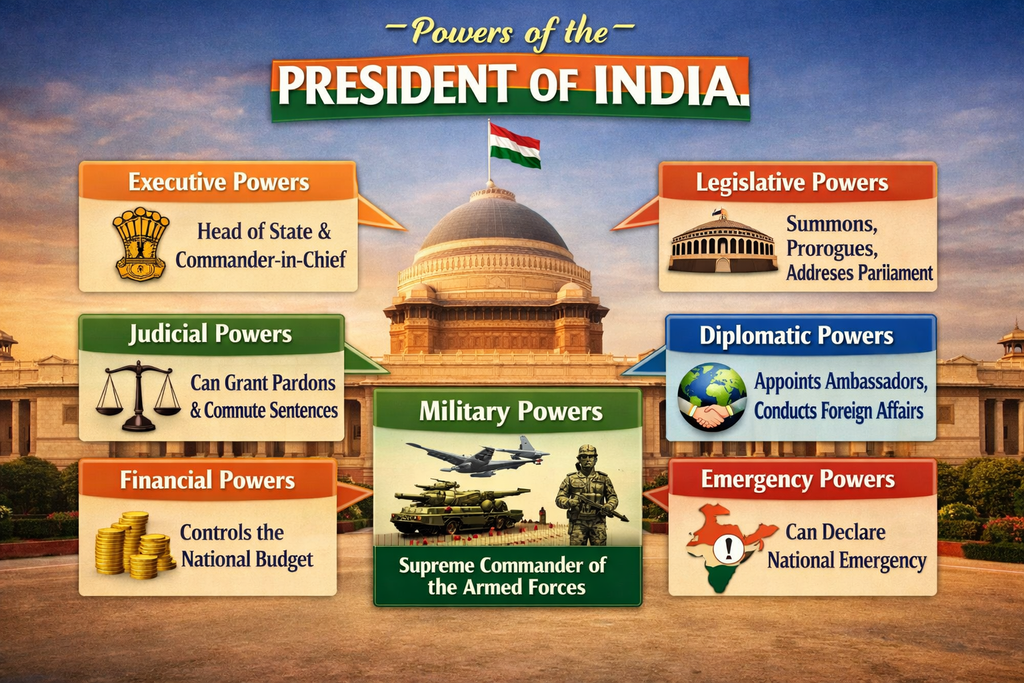
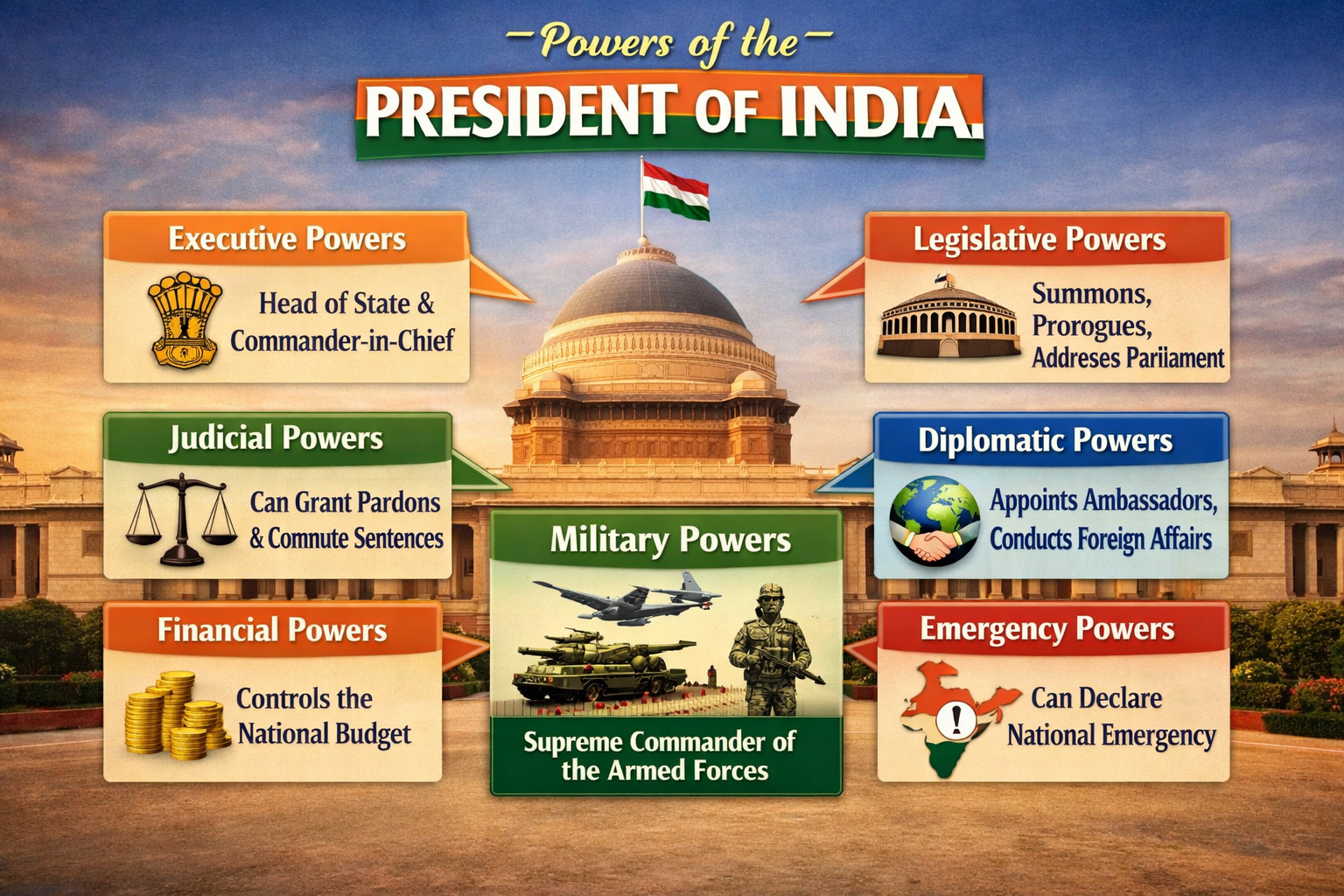
The powers and functions of the President of India are extensive, spanning executive, legislative, judicial, and emergency domains as defined by the Constitution of India.
Executive Powers and Functions
- The executive power of the Union is vested in the President and is exercised either directly or through subordinate officers in accordance with the Constitution.
- The supreme command of the Defence Forces of the Union is also vested in the President, with its exercise regulated by law.
- All executive actions of the Government of India are formally taken in the name of the President.
- The President appoints the Prime Minister and other Ministers on the advice of the Prime Minister, and they hold office during the President's pleasure.
- The President appoints several high-ranking officials, including the Attorney-General for India, the Comptroller and Auditor-General of India, and Governors of States.
- The President also appoints the Chief Election Commissioner and other Election Commissioners, subject to parliamentary law.
- The President has the power to make rules for the convenient transaction of government business and the allocation of work among Ministers.
Legislative Powers and Functions
- The President is an integral part of the Parliament of the Union, which consists of the President and two Houses.
- The President has the power to summon and prorogue both Houses of Parliament and dissolve the House of the People (Lok Sabha).
- At the start of the first session after each general election and at the commencement of the first session of every year, the President addresses both Houses assembled together.
- The President can send messages to either House regarding pending Bills or other matters.
- The President nominates twelve members to the Council of States (Rajya Sabha) based on their special knowledge in literature, science, art, and social service.
- Every Bill passed by Parliament must be presented to the President for assent; the President may give assent, withhold it, or (if not a Money Bill) return it for reconsideration.
- When Parliament is in recess, the President can promulgate Ordinances if immediate action is necessary, which have the same force as an Act of Parliament.
Judicial Powers and Functions
- The President appoints the Chief Justice and Judges of the Supreme Court and High Courts.
- The President has the power to grant pardons, reprieves, respites, or remissions of punishment, and to suspend, remit, or commute sentences, particularly in cases involving court-martials, death sentences, or offences against Union laws.
- Under Article 143, the President may consult the Supreme Court on any question of law or fact of public importance.
Financial Powers and Functions
- The President causes the Annual Financial Statement (Budget) to be laid before both Houses of Parliament each financial year.
- No demand for a grant can be made in Parliament except on the recommendation of the President.
- The President constitutes a Finance Commission every five years to recommend the distribution of taxes between the Union and the States.
- The Contingency Fund of India is at the disposal of the President to meet unforeseen expenditure pending parliamentary authorisation.
Emergency Powers
- National Emergency: If satisfied that a grave emergency exists threatening the security of India by war, external aggression, or armed rebellion, the President can issue a Proclamation of Emergency.
- State Emergency (President’s Rule): If satisfied that a State government cannot be carried on according to the Constitution, the President can assume the functions of the State government.
- Financial Emergency: If the financial stability or credit of India is threatened, the President may proclaim a financial emergency.
Relationship with the Council of Ministers
- There is a Council of Ministers, headed by the Prime Minister, to aid and advise the President.
- In the exercise of their functions, the President must act in accordance with this advice, though they may require the Council to reconsider such advice once.
- The Prime Minister is duty-bound to communicate all decisions of the Council of Ministers and proposals for legislation to the President.
Constitutional Protections
- The President is not answerable to any court for the exercise and performance of the powers and duties of their office.
- No criminal proceedings can be instituted against the President during their term of office, and no process for their arrest or imprisonment can be issued.